Why the order matters
A demolition in Bundaberg is a short job wrapped in a long lead time. The machine work on an ordinary house takes days. Getting to the point where the machine can legally and safely start takes weeks, because several organisations each have their own process and will not act until another has finished. Ergon will not abolish a service line until the retailer raises the request. A removalist will not touch asbestos until the Form 65 has been lodged five days ahead. The certifier's approval has a clock on it under the Building Act. Doing these in the wrong order is how a three week job becomes a three month one.
The list below is in the order we usually work through it with owners. Not every item applies to every block, but run down the whole list once, because the item you skip is the one that stops the job.
- Engage a certifier and get the approval issued.
- Asbestos survey.
- Electricity abolishment, with Ergon's written confirmation.
- Gas: AGN reticulated or LPG bottles collected.
- Water and sewer disconnection by council.
- NBN lead-in.
- WHSQ notification where it applies.
- Road reserve permit for skips or traffic management.
- Neighbours and dust.
- Trees.
- Pest and termite treatment records.
- What to keep.
Approval and asbestos
1. The certifier and the approval
Demolishing a building is building work under the Building Act 1975, which means it needs a building approval before it starts. In Bundaberg that approval comes from a QBCC-licensed private building certifier; council stopped certifying on 7 September 2015. The certifier checks whether the planning scheme is triggered (heritage and character overlay, local heritage place, flood overlay) and, where it is, the application goes to council first or council is a referral agency. For an ordinary house outside the overlays, the certifier can usually issue the demolition approval without a council planning application, though the certifier decides that.
Timing matters because of section 71 of the Building Act. Demolition, removal or rebuilding work must substantially start within two months of the approval and be completed within one year, with one extension of up to six months available from council. The certifier confirms the current conditions. The practical lesson is not to have the approval issued months before you are ready; line up the contractor, the asbestos removal and the disconnections first so the two month window is not wasted waiting on Ergon. More on permits and licences.
2. Asbestos survey
WHSQ presumes asbestos in any building built before 31 December 1989 until a sample shows otherwise. The usual places are fibro cladding and eaves, wet area linings, vinyl floor backing, the old switchboard, some fencing. A survey by a competent person identifies what is there, how much and whether it is bonded or friable. That drives whether a Class B licence (more than 10 square metres bonded) or Class A licence (any friable) is needed, whether a Form 65 goes to WHSQ five days ahead, and how much ends up at University Drive at $208 a tonne. Get the survey done early because the removal has to be complete and cleared before the demolition machine starts, and the removalist needs the survey to quote. See asbestos removal before demolition.
Services off
3. Electricity
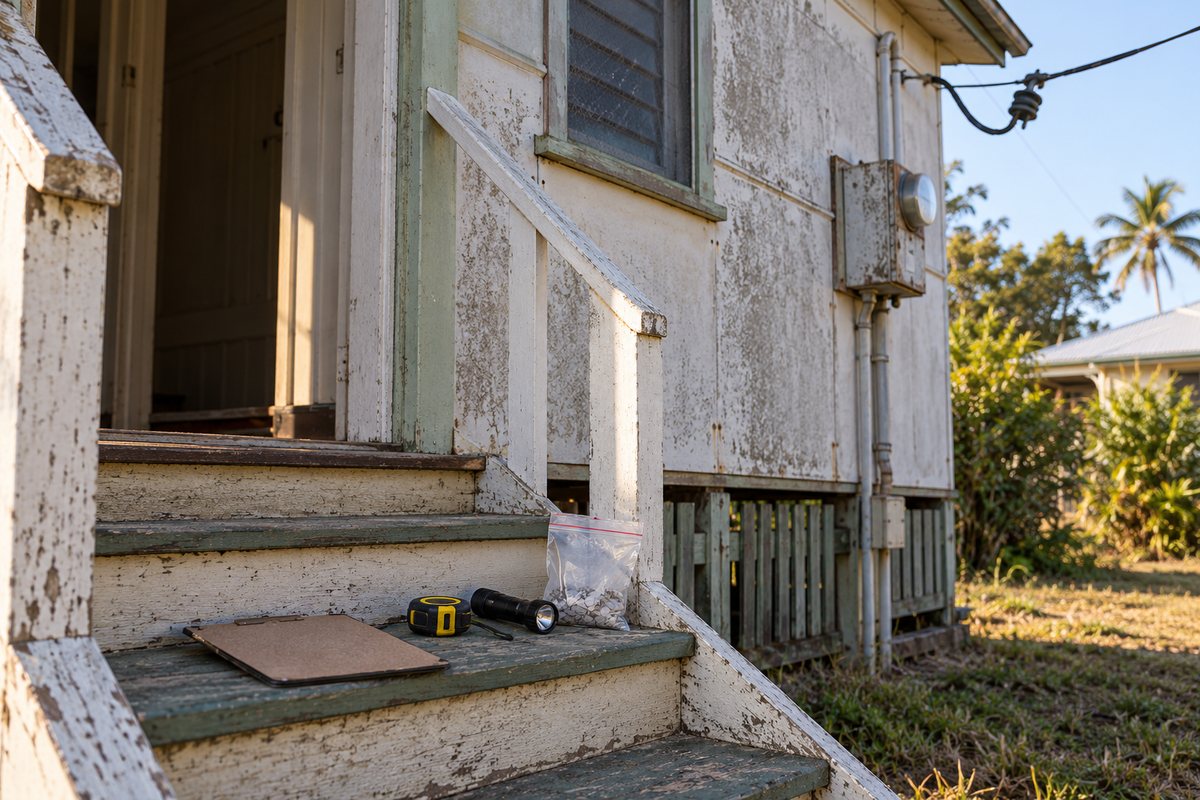
The single most common hold-up. Electricity removal, which Ergon calls abolishment, is requested through your electricity retailer, not Ergon directly. The retailer raises the request, Ergon removes the service line and meter, and the NMI is cancelled. For an urban removal Ergon works to 20 business days. The 2026-27 fees are $485.15 for the service line removal and $107.33 for the meter removal, both ex GST, billed through the retailer. The demolition must not start until Ergon has confirmed in writing that the removal is done; a dead meter is not proof, and neither is a disconnected switchboard. If a contractor offers to pull the line down themselves, find another contractor. Start this the day you decide to demolish.
4. Gas
Bundaberg has a reticulated natural gas network operated by Australian Gas Networks as well as a large number of homes on LPG bottles. If there is a gas meter on the wall, the connection is disconnected through AGN; ask them for the current lead time and any fee. If the house runs on bottles, the supplier collects them and the regulator and pipework are capped. Either way, nobody should be cutting into a house with live gas in it, and the contractor will ask for confirmation.
5. Water and sewer
Under council's policy OP-3-058, only council staff disconnect a property from the water and sewer mains. The owner applies on the Notice to Service Provider form, pays the fee before approval, and council does the disconnection at the main. All services are to be disconnected before removal or demolition begins. If the block is unsewered and has a septic system, a separate compliance permit to disconnect and remove the on-site sewerage facility applies ($650 for 2026-27), and the tank and trenches come out as part of the clearing. Ask council on 1300 883 699 for the current water and sewer disconnection fee.
6. NBN
The NBN lead-in and connection box have to be dealt with too. NBN Co treats removal of its assets as modification works quoted case by case; lodge the request through its connection box removal process and expect a lead time. A lead-in torn out by the machine is a cost and a potential fault on the street.
Notifications and permits
7. WHSQ notification
Separate from the building approval, some demolition work has to be notified to Workplace Health and Safety Queensland on Form 65 at least five days before it starts. The triggers are a load-bearing structure six metres or more high, load-shifting machinery working on a suspended floor, and explosives. A single storey house usually does not trigger the demolition notification; a high-set Queenslander, a two storey house, a commercial shed or a job where an excavator will work on an upper floor may. Licensed asbestos removal is always notified five days ahead on the same form. The contractor lodges these, but ask for a copy. Demolition itself in Queensland is licensed by WHSQ under the WHS Regulation 2011, and any job using an excavator, loader or skid steer needs the WHSQ demolition work licence; check the contractor's licence before you sign.
8. Road reserve permit
If a skip bin, a stack of materials, a hoarding or a traffic control setup will sit on the footpath or road, council's Use of Road Reserve permit is needed: $550 for 2026-27, renewal $183, through the application to carry out works within council's road reserve, with Engineering Services on 1300 883 699. On a narrow inner Bundaberg street where the tippers have to load from the road this is routine; on a wide block in Avoca where everything fits inside the boundary the skip is outside the road reserve rules; confirm with council if unsure. The contractor will usually know from the site visit.
The block and the neighbours
9. Neighbours and dust
There is no council form for this one, but it saves more trouble than most of the forms. Tell the neighbours on both sides and across the road what is happening, when, for how long, and give them the contractor's number. Agree where the fence line is and photograph shared fences before the machine arrives. Dust is controlled by wetting down as the house comes apart; asbestos work is done wet by law. On the red Woongarra loams around Bargara and The Hummock a dry windy day can lift a lot of soil off a cleared block, so ask what the contractor does about dust after the demolition as well as during it.
10. Trees
Trees on the block that are in the way of the machine or the tippers are usually removed as part of the job, but check first. Council advises that a permit may be required to clear protected plants or remnant vegetation under the Nature Conservation Act 1992 and the Vegetation Management Act 1999, and the planning scheme's vegetation management code applies where the Biodiversity areas overlay is mapped. Clearing for an urban purpose on an ordinary freehold urban lot is generally exempt under state rules, but if the block is on the fringe, backs onto a creek or has large native trees, ask council's duty planner before anything is felled. Street trees on the verge are council's; ask before touching them.
11. Pest and termite records
Dig out any termite inspection or treatment records for the house. Termites are a problem throughout Queensland and the NCC Queensland variation requires a termite management system with a 50 year design life on new construction, so whoever builds on the block next will want to know what was there. A treated zone around old stumps, a chemical barrier under a slab or active termites in the frame all affect how the demolition is done and what the site needs afterwards. If the house is being removed rather than demolished, the removalist needs the records too.
12. What to keep
Before the paperwork goes in the skip with the house, keep: old building approvals and plans, engineer's letters (especially for slabs, retaining walls and pool shells), the asbestos survey and clearance certificate, Ergon's written confirmation, council's disconnection receipt, the certifier's demolition approval and final inspection, tip dockets if the quote is charged on weight, and any pool decommissioning paperwork. The next certifier, the next builder and your insurer will ask for some of it. Keep photos of the block before, during and after as well.
An experienced contractor runs most of this list for you and tells you which items are yours. The cost guide explains what each step does to the price. When you are ready, send through the address and a few photos and we will tell you which items your block actually needs.
What this page cannot do
This page cannot replace the certifier, who decides what approval your demolition needs and what conditions attach to it, or council's duty planner, who confirms whether the planning scheme or a vegetation permit applies to your block. It cannot tell you what Ergon, AGN, NBN Co or council will charge or how long they will take on a given day; the figures here are the published 2026-27 rates and the stated service standards, and each organisation confirms its own. It is not a safety plan, a licence check or legal advice. A contractor's WHSQ licence and asbestos licence should be verified with WHSQ, not assumed from this list.
Check the current rules before you rely on this
This page describes the approvals, disconnections and notifications an owner usually needs to complete before a demolition can start in the Bundaberg region. It describes the rules in general terms as they stood in October 2026. Standards, forms, thresholds and fines change.
The authoritative sources are Building Act 1975 section 71, when demolition and removal must start and be completed, Ergon Energy, removal of an electricity connection, Bundaberg Regional Council policy OP-3-058, connecting to and disconnecting from water and sewer infrastructure, Workplace Health and Safety Queensland, demolition notifications, ABLIS, approval for works on public areas and roads, Bundaberg Regional Council and Bundaberg Regional Council, native plants and vegetation clearing. Where anything here differs from those sources, they are right and we are not.
We are not building certifiers, engineers, planners or lawyers. For what applies to your property, ask a licensed building certifier or ring Bundaberg Regional Council on 1300 883 699.
Accurate at the time of writing, October 2026. Always check the source before relying on it.