Demolition is building work, so it needs a building approval
Most owners are surprised that knocking a house down is treated the same way as putting one up. Section 5 of the Building Act 1975 defines building work to include "moving or demolishing a building or other structure", and under section 20 almost all building work is assessable development. In plain terms, you need a building approval before a contractor starts on your block, whether the house is in Bundaberg East, Kepnock or out at Gin Gin. The Act is on the Queensland legislation site.
In the Bundaberg region that approval comes from a private building certifier licensed by the QBCC. Bundaberg Regional Council stopped certifying on 7 September 2015; council's planning and building approval page points you to the private market. The certifier checks the application, confirms whether any overlay or referral applies, and issues the approval with conditions. The certifier sets their own fee, so get two or three quotes.
The Act puts a clock on it. Under section 71, demolition, removal or rebuilding work must substantially start within 2 months of the approval and be completed within 1 year, and the local government can grant one extension of up to 6 months, after which the approval lapses. We write that from the in-force wording of section 71; the certifier confirms the current conditions when they issue your approval, so plan the contractor's start date around them rather than getting the approval months ahead and letting it sit.
The practical sequence is: engage a certifier, lodge the demolition application, get the approval, then book the contractor. Our checklist walks through the order, including the service disconnections that have to be finished first.
When a planning application is needed as well
A building approval is not always the whole story. If your property is mapped under the Heritage and neighbourhood character overlay in the Bundaberg Regional Council Planning Scheme 2015, a development application to council may be needed before the certifier can approve the demolition. In a neighbourhood character area, which covers the older timber and tin suburbs and the Bundaberg and Childers town centres, a development application is required to demolish, relocate or remove a Victorian, Federation or Interwar building. For the 79 local heritage places, demolition needs a development application and council's fact sheet says it is generally not supported unless there is no prudent or feasible alternative. Bundaberg does not use Brisbane's pre-1946 rule; the test is the era and the mapping, not a year.
State heritage is a separate layer. The region has 54 places on the Queensland Heritage Register, and anything on it needs approval from the Department of the Environment, Tourism, Science and Innovation (DETSI), not council; council's heritage properties page lists the contact. The heritage and character page covers all of this in depth.
On fees, code assessment triggered only by the heritage or flood hazard overlay carries no council charge in 2026-27, while building works involving demolition of a local heritage place are $1,770, per council's 2026-27 fees and charges.
The contractor's licence: WHSQ, not QBCC
This is the part that trips up owners and some builders. Demolition contractors in Queensland are licensed by Workplace Health and Safety Queensland (WHSQ) under the Work Health and Safety Regulation 2011. The licence is a demolition work licence, issued to the business, valid for 2 years and applied for on Form 76. The WHSQ demolition licence page sets out exactly when it applies.
The rule has two halves. First, any demolition involving one of three features needs the licence: pre-tensioned or post-tensioned concrete, load-shifting machinery (front-end loaders, backhoes, skid steers, excavators, cranes), or explosives and induced collapse. Second, all other demolition also needs the licence unless the structure is a domestic house, a building converted from a house, or something ancillary such as a carport or garage, and none of those three features is involved. The conclusion for a typical Bundaberg job is clear: a house pulled down with an excavator or skid steer needs the WHSQ licence, because the machinery takes it outside the domestic exemption, which really only covers hand demolition.
Processing can take up to 120 days according to the ABLIS entry for the licence, so a contractor cannot apply the week before your job. WHSQ publishes a spreadsheet of licensed contractors on the same page, the simplest way to check a name.
Alongside the licence sit the WHS Regulation duties. Section 143 says a person conducting a business or undertaking must not carry out demolition work that requires a licence unless they hold one. Section 144 requires a nominated supervisor to be available and workers to be trained. Demolition is also construction work, so a safe work method statement is needed for demolition of load-bearing elements. The WHSQ demolition hazards page has the detail; a structural collapse is a notifiable dangerous incident.
| Authority | What it issues or controls | Trigger | Fee (2026-27 unless stated) |
|---|---|---|---|
| Private certifier (QBCC-licensed) | Building approval, with s 71 time limits | Any demolition of a building | Set by the certifier |
| Council, planning | Development application | Victorian, Federation or Interwar building in a character area; any local heritage place | $0 overlay-only; $1,770 local heritage demolition (2026-27) |
| DETSI | State heritage approval | 54 Queensland Heritage Register places in the region | Ask DETSI |
| WHSQ | Demolition work licence (Form 76, 2 years), Form 65 notices, asbestos licences | Machinery, tensioned concrete, explosives; structures 6 m or higher; asbestos | Last published 2024-25: $106.11 demolition licence |
| Council, engineering | Road reserve use permit, works on roads approval | Skips, materials, traffic control or works in the road reserve | $550 permit, $183 renewal (2026-27) |
| QBCC | Contractor licence for the building work that follows | Building work over $3,300 | Not the demolition itself |
Notifying WHSQ before certain jobs
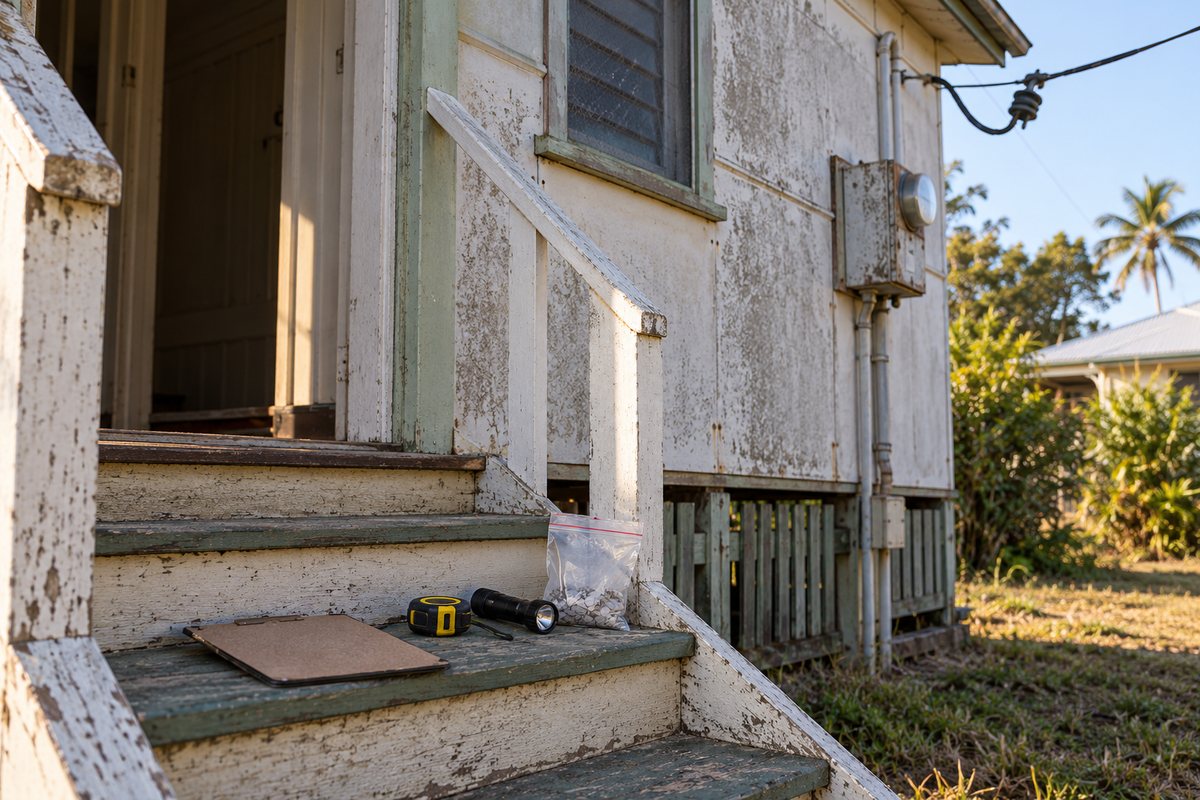
Separate from the licence, some demolition work has to be notified to WHSQ on Form 65 at least 5 days before it starts. The WHSQ demolition notification page lists three triggers: a load-bearing structure 6 metres or more high, load-shifting machinery on a suspended floor, and explosives. A single-storey house on stumps usually sits below the 6 metre line, but a high-set Queenslander with a tall roof can get close, and a two-storey building in the CBD is well over it. The contractor decides, but ask, because it affects the start date. Licensed asbestos removal has its own 5-day Form 65 notification, and because WHSQ presumes asbestos in any building built before 31 December 1989 until a sample shows otherwise, it is the more common of the two; the asbestos rules page explains the licences and the clearance certificate.
Where QBCC does and does not apply
QBCC's "do you need a licence" page lists "a demolition worker" among the trades that do not need a QBCC licence and sends them to WHSQ. There is no QBCC licence class called demolition; the classes in the QBCC Regulation are builder low rise, medium rise and open, and their scopes do not mention demolition. The position is on the QBCC licence page. So when a contractor says they are "QBCC licensed for demolition", ask what they mean. They may hold a builder's licence, which is fine, but it is not the demolition licence.
QBCC does apply to what comes next. Building work worth more than $3,300 including labour and materials needs a QBCC-licensed contractor, so the new slab, house or shed is QBCC territory; the QBCC page on when a contractor licence is required explains the threshold. If one company is demolishing and rebuilding, check both licences. The penalty for unlicensed building work under section 42 of the QBCC Act is up to 250 penalty units for a first offence, which at the $172.70 penalty unit from 1 July 2026 is $43,175, rising for repeat offences. That penalty is about building work, not unlicensed demolition, which sits in the WHS Regulation. Owners sometimes assume the demolition contractor can throw in the new slab, and that is where section 42 bites. Pools are a related case; see pool demolition.
Council permits for the street and the site
Council is not the demolition approver, but it controls the road reserve. If a skip bin, a stockpile, a crane or traffic control will sit on the footpath or verge, you need a use of road reserve permit, $550 for 2026-27 with a renewal at $183. Works that disturb the road reserve, such as a new crossover, fall under Local Law 1 (Administration) 2011 and its subordinate local laws, on the form "Application to carry out works within council's road reserve". The ABLIS summary of council's works on roads approval sets it out; Engineering Services on 1300 883 699 handles applications. Most contractors keep the skip inside the fence to avoid the permit, but a narrow Walkervale block with no side access may not allow it.
If the house is being removed intact, council is a referral agency under its April 2026 removal and rebuilding policy and no longer requires a bond; ask council or the certifier what supporting reports (typically a structural engineer's report and transport route) the referral needs. The policy requires the removal site to be left clear of debris, stumps, foundations and wastewater systems. The Queenslander removal guide compares the two paths. Water and sewer disconnection is a council job too: only council staff disconnect, the owner applies on the Notice to Service Provider form, and all services must be off before demolition begins. Electricity abolishment goes through your retailer to Ergon.
How to check a contractor in five minutes
Start with WHSQ. Download the list of licensed demolition contractors from the demolition licence page and search for the business name, not the trading name on the ute. Ask to see the licence; it names the business and the expiry. If asbestos is involved, ask for the asbestos removal licence as well, Class B at least, or Class A if anything friable is present.
Then, if the same company will do building work afterwards, search the QBCC licensee register, which shows the class, status and conditions. Ask for the public liability certificate, and after the job for copies of the Form 65 notifications and asbestos control plan. Costs are on the cost guide, and you can request quotes once the approvals are in hand.
What this page cannot do
This page cannot tell you whether your particular property is inside a character area, on the local heritage list or under a flood or coastal overlay; only council's mapping and a certifier can confirm that. It cannot issue or speed up any approval, and it cannot confirm whether a specific contractor's WHSQ licence is current, because licences expire. The fees quoted are council's 2026-27 charges and WHSQ's last published 2024-25 figures, and they change each July. Nothing here replaces advice from a licensed building certifier, a town planner or a solicitor.
Check the current rules before you rely on this
This page describes the approvals, licences and permits that apply to demolition work in the Bundaberg region. It describes the rules in general terms as they stood in October 2026. Standards, forms, thresholds and fines change.
The authoritative sources are Building Act 1975 (Queensland), Building Act 1975 section 71, when demolition and removal must start and be completed, Bundaberg Regional Council, building and planning approvals, Workplace Health and Safety Queensland, demolition work licence, QBCC, do you need a licence and Bundaberg Regional Council Fees and Charges 2026-27. Where anything here differs from those sources, they are right and we are not.
We are not building certifiers, engineers, planners or lawyers. For what applies to your property, ask a licensed building certifier or ring Bundaberg Regional Council on 1300 883 699.
Accurate at the time of writing, October 2026. Always check the source before relying on it.