The suburbs that grew after the war
Bundaberg's inner suburbs date from the nineteenth century. The ring outside them is a different generation. Walkervale is a post-war suburb by any measure: its church went up in 1949, the state school opened in 1955 and the swimming pool followed in 1961. Avenell Heights was only named in 1967. Kepnock, Avoca, Svensson Heights, Norville and Thabeban broadly filled in across the same decades, and Millbank and Branyan on the western side generally carried the growth on later. These are the suburbs where most of Bundaberg's 85 per cent separate-house stock actually sits: single houses on blocks that are often large by city standards, with a carport, a shed and room for a pool.
That block size is why demolition in Kepnock, Avoca and Walkervale is overwhelmingly the knock-down rebuild. The region is growing at about 1.2 per cent a year on the council's planning review, from roughly 100,000 people in 2021 towards 119,000 by 2036, and the ABS counted 99,215 people in the local government area at the 2021 census with a median age of 47. A tired 1960s house on a big flat block near the hospital or the shops is often worth more as a cleared block than as a house. The house demolition page covers the job itself; this page is about what is particular to these streets.
Fibro means asbestos, and much of this housing is fibro
Much of the first wave of post-war housing in Walkervale, Avoca and Kepnock was built fast and cheaply, and in Queensland in the 1950s and 60s that generally meant fibre cement sheeting, which until the late 1980s contained asbestos. Low-set fibro on concrete or timber stumps, fibro gables on a timber frame, fibro eaves, fibro bathroom and laundry walls, and often an asbestos cement fence or a fibro shed behind. WHSQ presumes asbestos in any building built before 31 December 1989 until a sample shows otherwise, and in these suburbs that presumption does a lot of work.
A fibro house is therefore two jobs. The first is licensed asbestos removal: more than 10 square metres of non-friable sheeting needs a Class B licence, any friable material needs Class A, a removal control plan is prepared, the Form 65 notification goes to WHSQ at least five days before licensed removal starts, and after it finishes an independent competent person issues the clearance certificate. The removed sheets leave the site wrapped in two layers of 200 micron plastic, labelled, and go to the Bundaberg Waste Facility at 46 University Drive, the only facility in the region that accepts asbestos, at $208 a tonne from 1 July 2026. Only then does the second job, the demolition of the frame, roof and stumps, begin. Our asbestos removal page sets out how the two stages fit together and why they usually cannot be combined.
| Era | Typical house in these suburbs | What that means for demolition |
|---|---|---|
| Late 1940s to 1960s | Low-set fibro on stumps, timber frame, iron or tile roof | Asbestos presumed; licensed removal stage first; lightweight frame comes down quickly |
| 1960s and 1970s | Brick veneer on a slab, tile roof, fibro eaves and wet areas | Asbestos in eaves and wet areas; heavier masonry and slab; concrete sorted for the $240 a tonne rate |
| 1980s and 1990s | Brick or rendered masonry, often Millbank and Branyan | Asbestos possible before 1990; mostly concrete and brick tonnage; pools common |
Brick veneer and the weight of the 1970s
From the late 1960s and through the 1970s, much of the new housing in Kepnock, Avenell Heights and Svensson Heights was broadly brick veneer on a concrete slab with a tile roof. They are a different demolition. There is less asbestos, usually just the eaves, the bathroom linings and sometimes the vinyl floor tiles, but there is far more weight. A brick veneer house with a slab, a driveway, paths and a brick fence can run to many tonnes of masonry and concrete, and at $359 a tonne for mixed construction and demolition waste from 1 July 2026 the way the contractor sorts it decides the tip bill. Clean concrete separated from the bricks, mesh and rubbish goes in at $240 a tonne at University Drive. The concrete and driveway page and what happens to the waste explain the sorting.
The slab is the other difference. A fibro house on stumps leaves a block that can be cleared with a small machine and a tipper. A slab house needs an excavator with a hammer to break the slab and footings, and foundations come out rather than being buried: Council's April 2026 removal policy requires a removal site to be cleared of debris, stumps, foundations and wastewater systems, and builders expect the same of a demolished block. On the red Woongarra loam that runs through much of Kepnock towards the coast the footings come out cleanly.
Pools in the back yard
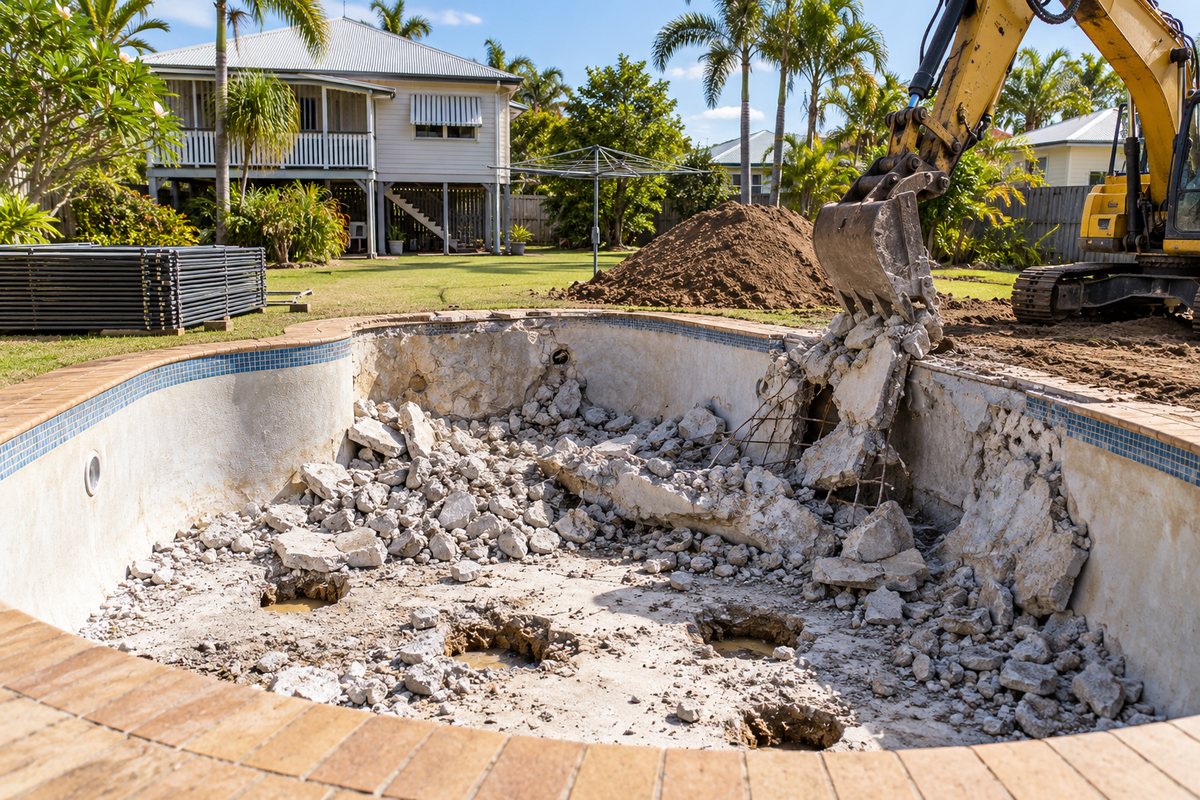
Backyard pools are common on these blocks, and a pool changes the sequence. Decommissioning or demolishing a pool may itself need building approval through the private certifier, and the one rule owners get wrong is the fence: the pool barrier must not come down until the certifier has issued the demolition approval, because until then it is still a pool under the safety laws. A decommissioned pool left in the ground must not hold more than 300 mm of water. After the work, the owner writes to [email protected] to have it removed from the pool safety register.
In a full knock-down the pool is usually broken through and filled by the same excavator that does the house, and the fill compaction matters because the new house or its driveway may sit over it; the certifier may ask for an engineer's compaction certificate. Our pool demolition page covers the fill, the compaction and the paperwork.
Mango trees, palms and the vegetation question
Every second back yard in Walkervale and Norville has a mango tree the size of a house and a row of golden cane or cocos palms along the fence. Most owners want them gone with the building. We have found no local tree law, and the council's native plants page says a permit may be required only to clear protected plants or remnant vegetation under the Nature Conservation Act 1992 and the Vegetation Management Act 1999. A planted mango or an exotic palm in a suburban yard is neither, and clearing for an urban purpose on freehold land in an urban area is exempt under the Planning Regulation 2017. We found no local tree law and the state exemption covers urban clearing on freehold land, but ask the duty planner before felling. Where a lot is mapped in that overlay, which is unusual in these suburbs but not impossible on the creek lines through Avoca and Branyan, the vegetation management code applies and the council should be asked first.
The practical issue is the tonnage. A big mango and a dozen palms are a lot of green waste at $160 a tonne from 1 July 2026, with a $35 minimum, and a contractor will often mulch on site or have the green waste removed separately rather than mix it into the demolition skip at the higher rate.
Where these suburbs sit against the character overlay
This is the question people from Brisbane ask, and the answer here is different. Bundaberg does not use Brisbane's pre-1946 test. Under the Bundaberg Regional Council Planning Scheme 2015, a development application to demolish is required for a Victorian, Federation or Interwar building in a mapped neighbourhood character area, and for the 79 local heritage places. The council's heritage properties page describes the character areas as the older timber-and-tin suburbs around the town centre and the Childers town centre. Walkervale, Kepnock, Avoca and Avenell Heights are broadly post-war suburbs, so a house built there in 1958 is not a Victorian, Federation or Interwar building and is not in the mapping. For most post-war lots the planning answer is that there is nothing to apply for, and the only approval is the certifier's building approval under the Building Act, with the section 71 clock of two months to start and one year to finish; the certifier confirms the current conditions.
We hedge that because suburb boundaries are not era boundaries. The older edges of Walkervale and Norville towards Bundaberg South, and parts of Kepnock towards Bundaberg East, have pre-war timber homes mixed in with the fibro, and an individual lot may be mapped even when the street around it is not. A call to the duty planner on 1300 883 699 or an email to [email protected] before engaging a certifier costs nothing, and code assessment triggered only by the heritage overlay has no council fee if it does turn out to apply. The heritage and character page explains the application if your lot is one of the exceptions.
The rest of the knock-down is the standard Bundaberg sequence: electricity abolished through the retailer with Ergon's 20 business day urban timetable and written confirmation before work starts, water and sewer disconnected by council staff on the Notice to Service Provider form, a Use of Road Reserve permit at $550 if a skip sits on the verge, and a cleared, level block at the end. The checklist lists every step. When you are ready, ask for a quote with the year the house was built, whether it is fibro or brick, and whether there is a pool.
What this page cannot do
This page cannot tell you whether your particular lot in Kepnock, Avoca or Walkervale is inside the Heritage and neighbourhood character overlay or the Biodiversity areas overlay; only the council's mapping and the duty planner can. It cannot confirm that a house is fibro or that the fibro contains asbestos; a licensed removalist and a laboratory sample do that. It does not issue building or pool approvals, which come from a QBCC-licensed private certifier, and it does not quote demolition work. Era descriptions of these suburbs are general and individual houses vary. Use it to understand the usual shape of a post-war knock-down, then check your own block.
Check the current rules before you rely on this
This page describes knock-down rebuild demolition of post-war fibro and brick houses in Kepnock, Avoca, Walkervale and the surrounding suburbs of Bundaberg. It describes the rules in general terms as they stood in October 2026. Standards, forms, thresholds and fines change.
The authoritative sources are Wikipedia, Walkervale, Wikipedia, Avenell Heights, ABS 2021 Census QuickStats, Bundaberg local government area, Bundaberg Regional Council planning scheme review, population and dwelling projections, Workplace Health and Safety Queensland, asbestos removal licences and QBCC, decommissioning a pool. Where anything here differs from those sources, they are right and we are not.
We are not building certifiers, engineers, planners or lawyers. For what applies to your property, ask a licensed building certifier or ring Bundaberg Regional Council on 1300 883 699.
Accurate at the time of writing, October 2026. Always check the source before relying on it.